
Microsoft Ignite 2025 delivered a set of updates that directly affect how health systems think about Epic performance, AI adoption, and their cloud strategy. The themes were clear: Azure is advancing fast, AVD adoption is becoming more flexible, and Epic’s partnership with Microsoft is more visible and mature than ever.
Below are the takeaways that matter most if you’re responsible for the reliability, scalability, and future direction of your Epic environment.
1. Hybrid AVD expands how hospitals can approach clinical desktops
One of the most meaningful announcements this year was Hybrid Azure Virtual Desktop (AVD).
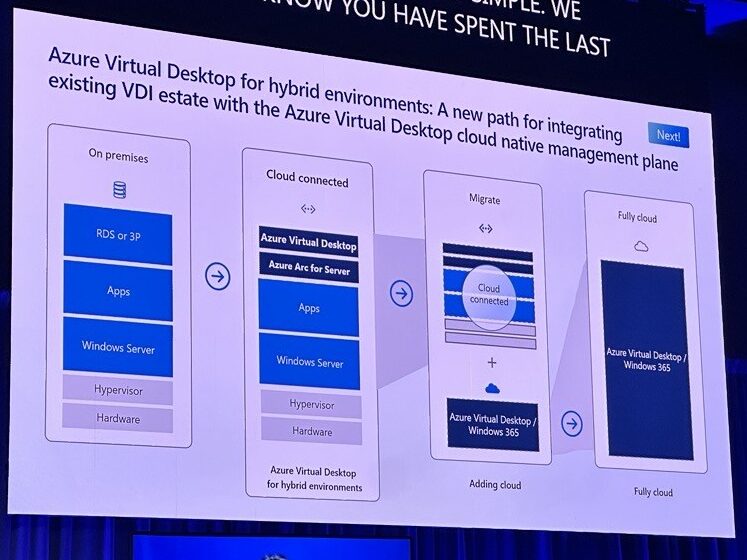
In previous models, VDI was largely an “either/or” choice – either you ran desktops locally, or you moved them fully to Azure. Hybrid AVD changes that. It offers a phased, blended approach that lets hospitals run sessions locally during planned transitions, or when a network disruption impacts cloud connectivity.
Microsoft demonstrated a four-phase pathway:
- On-prem
- Cloud-connected
- Migrate / adding cloud
- Fully cloud-based
Why this matters for Epic environments:
- Adds local failover options for clinical areas if cloud connectivity is disrupted
- Expands support for Community Connect, affiliated physicians, and temporary clinical staff via guest access
- Offers a modernization path for organizations looking to reduce Citrix
- Lets hospitals operate in “both worlds” while preparing for full cloud VDI
Ignite also made B2B external identities for AVD generally available – a win for health systems supporting affiliates and partner practices.
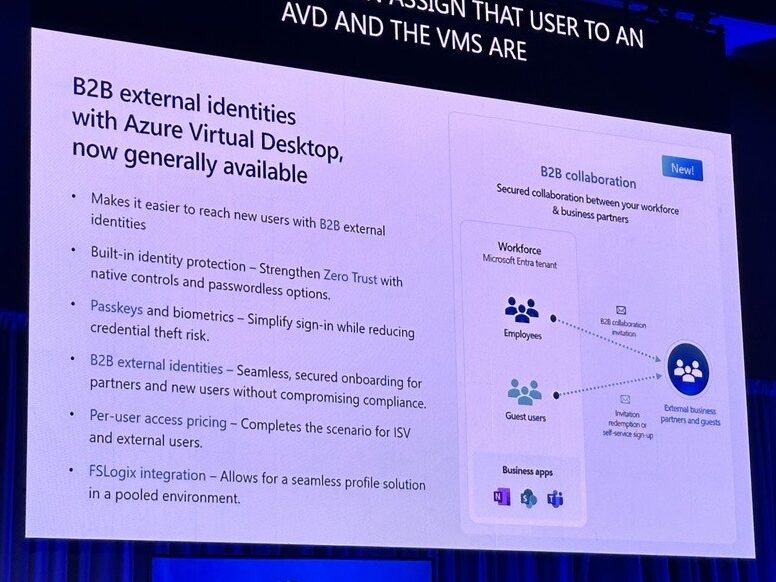
EHC is already working with multiple Epic customers evaluating AVD today, and these new hybrid and guest-access controls add even more flexibility for health IT leaders planning their next-generation workspace strategy.
2. Epic’s visibility in the keynote signals deeper alignment with Microsoft
Epic’s inclusion in the Microsoft keynote highlighted the continued momentum behind their collaboration on AI and cloud performance.
Microsoft showcased live front-end Epic workflows, including Hyperdrive and AI-enabled features. Epic typically reserves this content for its own conferences, so seeing it at Ignite reflects how closely the two organizations are working together.
Technical updates worth noting:
- Azure scalability validated up to 110M GRefs/s
- Instant snapshots are available today for certain non-production Epic environments, with production supported in future releases
- NVMe live expansion showcased using Community Health Network’s post-migration experience, demonstrating zero-downtime storage scaling
These improvements reinforce what we’ve seen across our Epic on Azure customers: Azure continues to close the operational gaps that previously made some health IT leaders hesitant.
3. AI dominated Ignite but CIOs / CTOs should balance excitement with readiness
AI was the centerpiece of Ignite – from Agentic AI to healthcare-specific model catalogs to new tools like Microsoft Dragon Copilot. Microsoft announced:
- A 50-model healthcare AI catalog
- Premium imaging and X-ray report-generation tools
- A healthcare model evaluator for validating accuracy and compliance
- Windows 365 for agents, supporting AI-enabled Cloud PCs
- A new Microsoft Dragon Copilot focused on documentation and routing workflows
Microsoft also highlighted early adopters evaluating these tools.
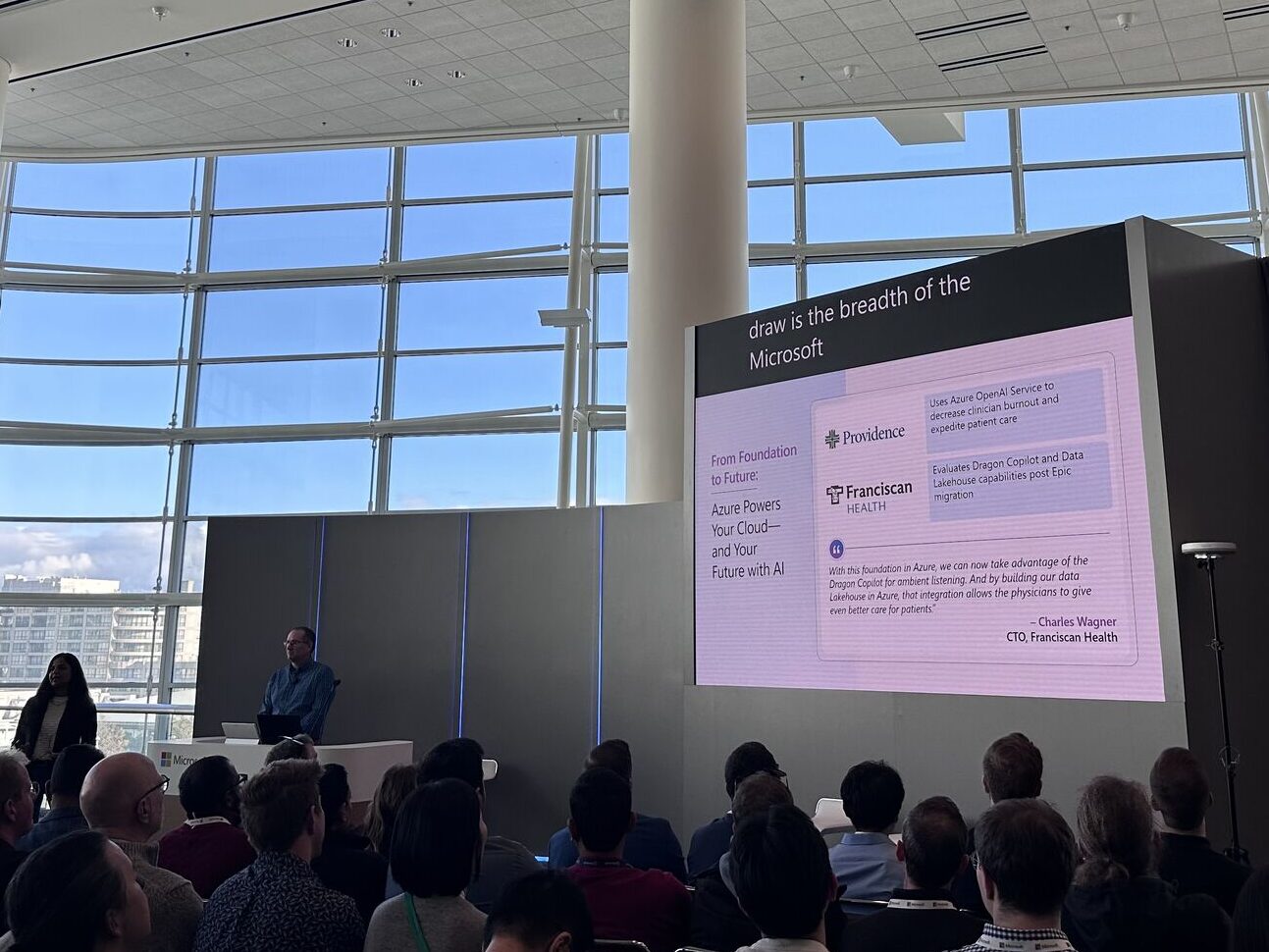
Charles Wagner, CTO at Franciscan Health, described how their move to Azure enabled them to begin evaluating Dragon Copilot and Azure Data Lakehouse capabilities:
“With this foundation in Azure, we can now take advantage of the Dragon Copilot for ambient listening. And by building our data Lakehouse in Azure, that integration allows the physicians to give even better care for patients.”
Charles Wagner, CTO, Franciscan health
Ignite included several AI demos that showed what’s possible, but like any emerging capability, real-world adoption will depend on operational readiness, workflow fit, and clinician confidence. CIOs should treat these tools as promising but still evolving, with an eye toward evaluating them thoughtfully as they mature.
4. The partner ecosystem around Epic on Azure keeps maturing
Microsoft highlighted Nerdio as a key launch partner for Hybrid AVD. Their early support for hybrid configurations aligns with what we’re seeing across our own customer evaluations – particularly for organizations exploring ways to modernize VDI while maintaining strong clinical performance and resiliency. Nerdio’s tooling continues to make AVD easier to manage at scale, which is valuable for health systems looking to balance cost, simplicity, and operational control during transition phases.
TL;DR: (or in summary…)
Ignite reinforced that Microsoft’s investments in Azure, AI, and virtual desktop modernization are directly benefiting Epic customers. For health systems still evaluating cloud options, the conversation is shifting. The question isn’t whether Azure can run Epic at enterprise scale – that’s already proven.
The real question is: when do you want access to the operational improvements and AI capabilities that are only available once you’re there?
About the author

Charles Knight has over 24 years of healthcare IT experience, with 17 years focused on Epic implementation, strategy and advisory for some of the largest hospital systems. Charles oversees daily operations and managed services, ensuring clients achieve operational excellence.
Previously, Charles held leadership roles at Virtustream, where he was responsible for customer success for the Virtustream Healthcare Cloud, and Microsoft, where he supported Epic on Azure implementations. His deep experience in implementation, strategy, and cloud transformation positions him as a trusted advisor to healthcare organizations.

Recent Posts
-
 Blog Post
EHC Consulting is Heading to Becker’s Health IT Conference 2026
Attending Becker’s 11th Annual IT + Revenue Cycle Conference, Sep 14–17, in Chicago? We’d love…
-
 Blog Post
Accelerate Your EHR Roadmap at UGM 2026
Heading to Epic® UGM 2026, August 17-20, in Verona? We’d love to connect with you!…
-
 Blog Post
4 Things Health IT Leaders Should Know About EHRs on Public Cloud After HIMSS 2026
At HIMSS 2026, one theme kept coming up in conversations with health systems and partners: moving EHRs…
