
At HIMSS 2026, one theme kept coming up in conversations with health systems and partners: moving EHRs and other critical systems to the public cloud is no longer an early adopter conversation. For most organizations, public cloud is now simply the foundation for what comes next.
1. Cloud is the starting point.
For years, the focus was whether to move to the cloud. At HIMSS this year, that conversation felt largely settled. Health systems aren’t asking if anymore. They’re asking:
“How does cloud fit into my broader strategy?”
“What does it actually enable?”
Once you’re in the cloud, the expectation is clear: better use of data, support for AI-driven workflows, and faster operational execution. Cloud adoption alone creates little value. It’s what you do after the move is what matters.
We’re seeing this shift and EHR on public cloud becoming standard practice across health systems.
2. AI is exposing more data problems.
If your data isn’t in order, AI won’t deliver value. There’s growing recognition that layering AI on top of fragmented or poorly structured data doesn’t work.
“Moving to the cloud opens up real opportunity to take advantage of AI, but it depends entirely on your data foundation. If your data isn’t in order or is still tied to on-prem environments, you’re going to struggle to unlock the full value of those capabilities.”
Dr. Tim Calahan, Co-Founder & Managing Member, EHC Consulting
This is where many organizations are getting stuck. AI can now handle scheduling, documentation, and coding – but only when it has access to clean, connected data across systems.
This evolution is reflected in platforms like Microsoft Dragon Copilot, which brings clinical intelligence and workflow automation directly into care delivery.
Without a unified data foundation, AI doesn’t scale, and outputs aren’t trusted.
3. Outcomes over everything.
Conversation about EHRs on public cloud used to focus on cost, security, and resiliency. While those are still critical topics, we are having many conversations about how cloud can ultimately help reduce clinician burnout, improve patient access, and eliminate administrative work.
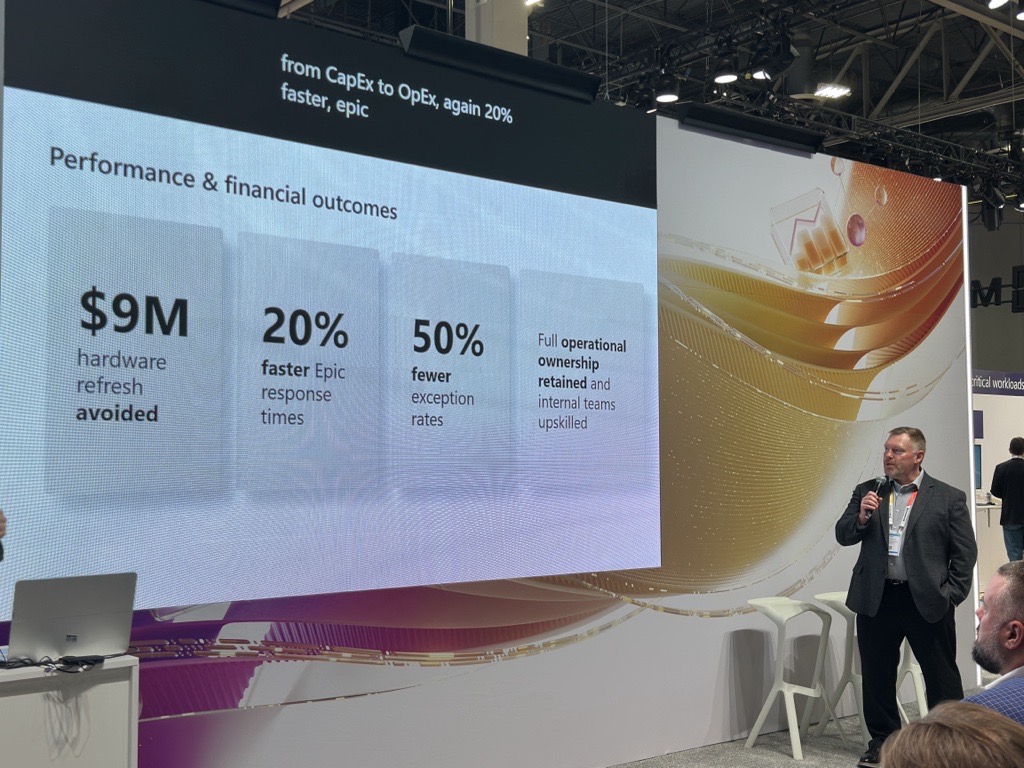
We’re already seeing this in practice. Community Health Network’s move to the public cloud resulted in 20% faster Epic response times and 50% fewer exception rates supporting both clinicians and patients.
This is a strong example of what’s possible when EHRs and other clinical systems are paired with modern cloud infrastructure and platforms.
4. Health systems need more results, not pilots.
There’s growing fatigue with theoretical use cases and AI that never makes it past the pilot stage. Health systems are asking for: shared vendor risk in pilots, measurable outcomes, and actual proof in production environments.
At HIMSS, Epic highlighted new capabilities like its no-code “Agent Factory,” designed to help health systems autonomously build and deploy AI directly within Epic workflows. They also shared how Epic AI is already helping health systems see measurable gains – saving hours of charting time, reducing claim denials, and reducing billing messages.
AI is starting to deliver real results like reducing call center burden, automating scheduling and documentation, accelerating billing cycles, and more. The gap is widening between organizations experimenting with AI and those that are operationalizing it.
What this means for health systems:
The limiting factor is cloud and AI readiness.
Health systems making progress have already moved core systems to the cloud, built a modern data foundation, and aligned IT with operational outcomes. This extends beyond the EHR – to imaging, revenue cycle, and other critical systems that need to operate as part of a connected, cloud-based environment. Others are struggling to move beyond pilots and get their data in order.
Where to focus next:
- Treat cloud as the foundation, not the finish line
- Prioritize data readiness before AI
- Focus on operational use cases
- Be intentional about where you pilot
The shift is already happening. How quickly can your organization take advantage of it?
About the author

Charles Knight has over 24 years of healthcare IT experience, with 17 years focused on Epic implementation, strategy and advisory for some of the largest hospital systems. Charles oversees daily operations and managed services, ensuring clients achieve operational excellence.
Previously, Charles held leadership roles at Virtustream, where he was responsible for customer success for the Virtustream Healthcare Cloud, and Microsoft, where he supported Epic on Azure implementations. His deep experience in implementation, strategy, and cloud transformation positions him as a trusted advisor to healthcare organizations.

Recent Posts
-
 Blog Post
Why Your Infrastructure is Holding Back Your AI Strategy: An AI Roadmap for Healthcare
A recent CHIME survey shows that a majority of health systems are either currently migrating…
-
 eBook
eBookA Healthcare Executive’s Guide to EHR Modernization
How healthcare leaders are reclaiming IT budgets, strengthening resilience, and building the runway for what…
-
 Webinar
Securing PHI and Governing AI as Clinical Systems Move to the Cloud
Escape legacy hardware delays and deliver frictionless, cloud-native EHR access to your clinicians.
